

.svg)


.png)
PRACTICAL AI Marketing Solutions
Ready to work together?
Find out where AI can add measurable value to your marketing engine and fuel confident growth.
AI isn't the risk. The risk is that 70% of marketers already know it's failing and only a third plan to do anything about it.
Andy Mills
06/03/2026
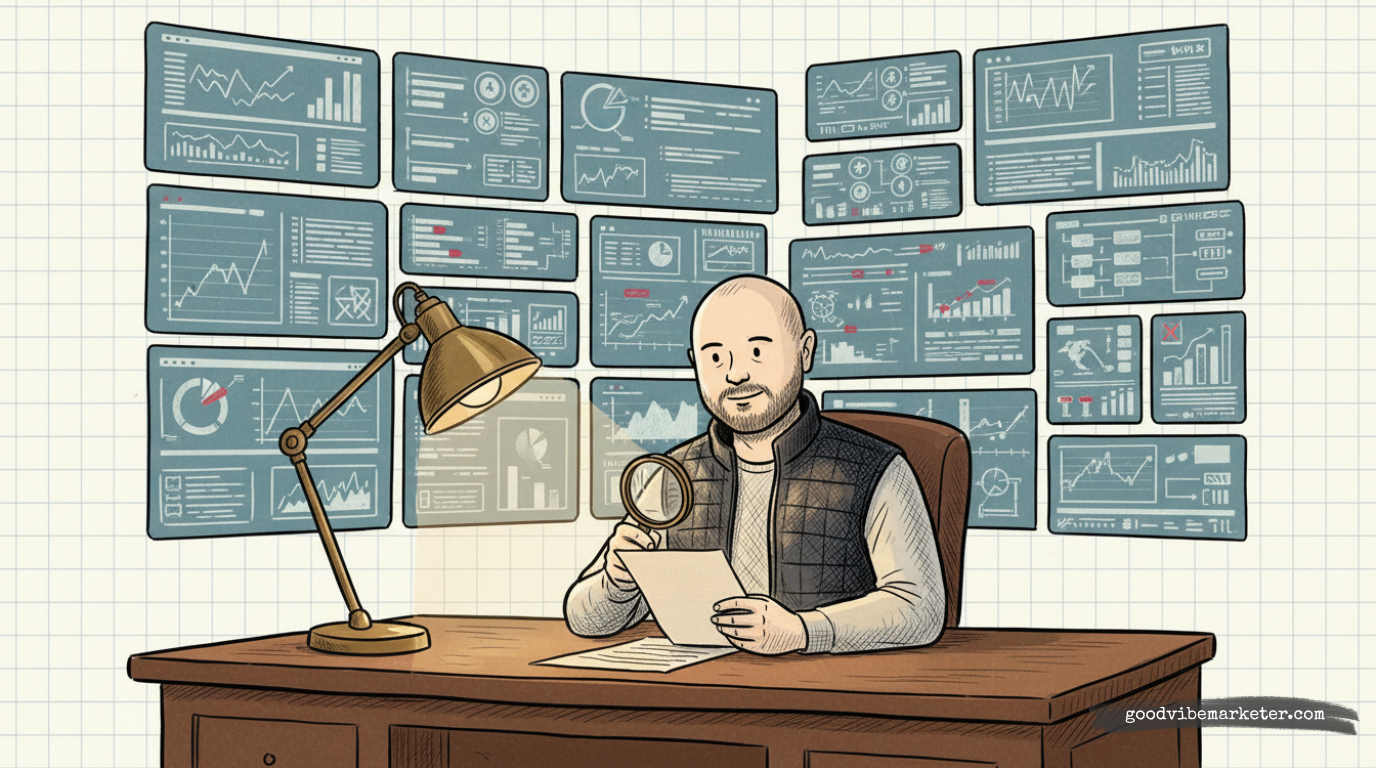
Seventy per cent of marketers have already encountered an AI integrity failure in their work. Hallucinations, bias, off-brand content. That's not a forecast, it's an IAB finding about things that have already gone wrong. Now hold that number against this one: fewer than 35% of those same marketers plan to increase investment in AI governance or brand integrity oversight in 2026.
That gap, between knowing the machine is misfiring and choosing not to build better guardrails, is the most important number in marketing right now. Not because it reveals a technology problem. Because it reveals a judgment problem. And judgment problems compound in ways that technology problems don't.
The conventional wisdom says the winners of the AI era will be the fastest adopters. The evidence from this month says something different: the winners will be the ones who built the infrastructure to govern what they adopted, while everyone else was still mesmerised by the capabilities.
.png)
Meta embedded its Manus AI autonomous agent directly into the Ads Manager interface in February 2026. Not as a beta. Not as an optional plugin. As a native layer inside the navigation advertisers use every day.
Manus, acquired by Meta in late 2025, executes multistep autonomous tasks: market research, report building, campaign analysis, all without requiring manual handoffs. The positioning is deliberate. Meta isn't offering you an AI tool. It's rebuilding the operating surface of its ad platform around an AI agent and expecting you to work within it.
This changes the core competency of paid media. The skill that mattered last year was knowing how to operate Ads Manager. The skill that matters now is knowing how to brief, constrain, and audit an AI agent operating inside it. Those are fundamentally different capabilities. One is execution. The other is oversight.
Most paid media teams haven't built that oversight muscle. The teams that start now, developing frameworks for agent briefing, output validation, and performance auditing at the agent level, will have a structural advantage that widens every quarter. The teams that don't will find themselves optimising campaigns they can no longer fully explain.
The important thing to notice here is that this wasn't optional. Meta made the architectural choice. You're working inside an agentic platform whether you've prepared for it or not.
.png)
Adobe's 2026 AI and Digital Trends Report surveyed 3,000 executives and 4,000 customers. The ambition numbers are striking: 80% want real-time personalisation, 72% want seamless cross-channel experiences, 60% want AI that still feels human and brand-aligned.
The readiness numbers are alarming: 78% of organisations expect AI agents to handle at least half of all customer support interactions within 18 months. Few report having the data architecture or governance frameworks to deliver that reliably.
Read that again. Nearly four in five organisations are planning to hand the majority of their customer conversations to AI agents they don't yet have the infrastructure to govern.
This isn't a technology adoption story. It's a brand risk story. Deploying agents before the infrastructure is ready doesn't produce mediocre customer experiences. It produces actively damaging ones, at machine scale, with your brand name attached. One poorly governed AI agent handling thousands of customer interactions per day can erode trust faster than any human team could rebuild it.
The brands Adobe identifies as "breakthrough" CX leaders aren't distinguished by their speed of AI adoption. They're distinguished by their investment in the boring parts: data architecture, governance frameworks, human oversight protocols. The operational plumbing that makes agentic AI safe to deploy, not just possible to deploy.
If your organisation is in the 78% planning aggressive agentic deployment, the honest question isn't "how fast can we ship this?" It's "what happens when the agent gets it wrong at 3 a.m. on a Saturday, and we don't catch it until Monday?"
.png)
New York Governor Hochul signed Senate Bill S8420A into law, making New York the first U.S. state to require advertisers to disclose when ads feature AI-generated synthetic performers. Civil penalties start at $1,000 for a first offence and escalate to $5,000 for subsequent violations.
The exemptions are narrow: audio-only ads, AI language translation, promotional materials for expressive works. The majority of AI-generated video and image creative featuring synthetic human talent falls squarely within scope.
For creative teams, this is no longer a philosophical conversation about transparency. It's a compliance obligation with financial penalties. Any brand running digital avatars or AI-generated spokespeople in New York-targeted campaigns needs disclosure infrastructure now.
More importantly, this is almost certainly a preview. Other high-population states will follow. The smart move isn't to treat this as a New York problem. It's to build disclosure workflows and creative asset tagging systems that can scale to a patchwork of state-level requirements, because that patchwork is forming in real time.
The brands that resist disclosure, or try to find loopholes, are making a bet that regulation will slow down. Every signal from 2025 and 2026 suggests the opposite. Building transparency into your creative production pipeline now is cheaper than retrofitting it under enforcement pressure later.
.png)
Net Conversion's March 2026 research, polling 900 U.S. adults, delivers what might be the most strategically consequential finding of the month: the consumer behavioural changes initially triggered by economic pressure have become permanent structural shifts.
Haley Gribben, Strategy and Insights Manager at Net Conversion, puts it directly: "What started as a response to economic pressure has become a permanent change in how consumers research, evaluate and commit to brands."
AI-assisted research tools are making consumers more deliberate, more comparative, more resistant to shortcuts. The purchase journey isn't just longer. It's fundamentally more intentional. And critically, this pattern doesn't reverse when economic conditions improve.
Marketers who are still modelling their funnels and attribution on pre-AI consumer behaviour are building on a false premise. The mid-funnel is where this miscalculation will hurt most. Consumers armed with AI research tools are spending more time evaluating, comparing, and stress-testing brand claims before committing. If your mid-funnel content can't survive that scrutiny, your top-of-funnel spend is increasingly wasted.
This is the non-obvious connection to the governance story. The same AI that's reshaping your internal operations is simultaneously reshaping how your customers decide whether to trust you. You're being evaluated by AI-empowered consumers while deploying AI you haven't fully learned to govern. Both sides of that equation demand better judgment infrastructure.
.png)
The strongest case against this thesis is straightforward. In a competitive market, the cost of moving slowly is real and measurable. Brands that delay AI deployment while building perfect governance frameworks risk falling behind competitors who ship faster, learn faster, and iterate faster. Governance, taken too far, becomes bureaucracy. And bureaucracy kills the agility that makes AI valuable in the first place.
This is a fair point. Over-engineering governance can be its own failure mode. Nobody wins by building a perfect compliance framework for a product that never launches.
But the evidence this month doesn't support the idea that the industry's problem is excessive caution. Seventy per cent of marketers have already hit AI failures. Fewer than 35% plan to invest more in governance. Seventy-eight per cent of organisations are racing toward agentic customer support without the infrastructure to deliver it safely. The industry's problem is not too much governance. It is almost none.
Speed and governance aren't opposites. The fastest sustainable adoption comes from teams that build lightweight but real oversight frameworks: agent briefing templates, output review cadences, escalation protocols, disclosure workflows. These don't slow you down. They prevent the catastrophic failures that actually slow you down.
.png)
Start with the gap the IAB data exposed. If your team is using AI tools, which it almost certainly is, and you don't have a documented process for catching failures before they reach customers, that's your first priority. Not a perfect framework. A functional one. An output review checklist, an escalation path, a human sign-off threshold.
Second, audit your paid media team's readiness for agentic platforms. Meta's Manus integration means the question isn't whether your team will work with AI agents. It's whether they know how to brief and audit one. Build that capability now, while the advantage is still available.
Third, check your creative pipeline for synthetic performer disclosure obligations. If you're running AI-generated human-appearing talent in any campaigns that target New York, you need a compliance workflow. Build it to scale to other states.
Fourth, revisit your mid-funnel content with the assumption that consumers are using AI tools to evaluate you. If your content can't survive a deliberate, comparative, AI-assisted research process, the problem isn't your ad spend. It's your substance.
The organisations that will be strongest twelve months from now aren't the ones that adopted AI first. They're the ones that built the judgment to govern it while everyone else was still celebrating what it could do.
That window is open. It won't stay open long.