

.svg)


.png)
PRACTICAL AI Marketing Solutions
Ready to work together?
Find out where AI can add measurable value to your marketing engine and fuel confident growth.
Most B2B companies have incomplete customer intelligence in their CRM. You know company names, but not what services they actually provide, making effective sales targeting and market segmentation impossible. This workflow changes that by automatically enriching HubSpot records with AI-powered business intelligence for less than one-tenth of a penny per company. Discover how multi-source data collection, combined with intelligent AI analysis identifies the specific information your sales and marketing teams need. Learn why this approach outperforms standard data enrichment services, how much it actually costs, and how you can deploy the same framework for your specific business needs.
Andy Mills
26 December, 2025

Most B2B companies share a frustrating reality. Your HubSpot system contains thousands of company records, yet the custom fields that matter most to your business sit mostly empty. You have fields designed to capture the specific information your sales and marketing teams need, but populating them manually would consume hundreds of hours of research. You could buy enrichment data, but standard vendors provide generic information, not the business-specific intelligence that answers your actual questions.
The challenge varies by industry. An insurance data company needs to know what insurance services each prospect offers. A SaaS company needs to identify which technology platforms prospects use. A recruitment firm needs to understand candidate specialisation areas. A professional services company needs to identify which industry verticals they serve. A manufacturing company needs to know production capabilities. In each case, the specific custom field differs, but the underlying problem remains identical: your CRM lacks the intelligent data you need to segment your market, qualify prospects effectively, and inform your marketing strategy.
You face the same unsatisfying choices regardless of your industry. Invest significant time in manual research. Pay hundreds of pounds for external data enrichment that provides generic information rather than the business-specific intelligence you need. Or accept working with incomplete information and hope your teams can function effectively without it.
There is a better approach that applies to any custom field and any industry. By combining multi-source data collection, artificial intelligence analysis, and automated HubSpot updates, you can populate your most important custom fields with intelligent, business-specific data. The cost proves negligible, typically less than one-tenth of a penny per company enriched.
What makes this approach fundamentally different from standard data enrichment is its flexibility and customisability. Rather than receiving pre-packaged company data from a vendor database, you deploy an AI agent tailored to your specific questions. The AI agent learns what business attributes matter to your organisation, analyses available information about each company, and populates your custom HubSpot fields with answers to your specific business questions.
For insurance data companies, this means identifying insurance services each company provides. For software companies, this means identifying technology stack. For recruitment firms, this means categorising candidate specialisation. For professional services, this means identifying industry verticals served. For manufacturing, this means identifying production capabilities. The workflow architecture remains identical. Only the business question, the data sources being analysed, and the custom field being populated change.
This is why the same framework scales across every industry and use case. You are not buying a product designed for a specific problem. You are deploying an intelligent system designed around your specific problem.
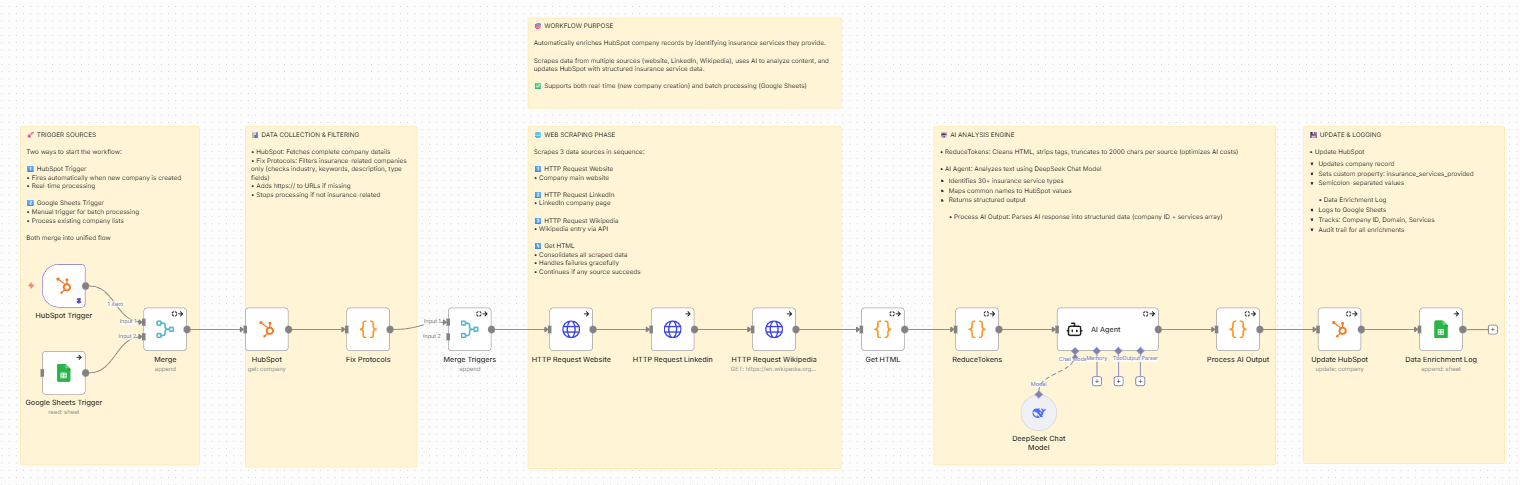
The system operates through four integrated phases, each building on the previous one. Understanding each phase helps you see how this approach delivers cost-effective intelligence regardless of which custom field you need populated.
The workflow operates in two modes, providing flexibility for both real-time and batch processing. When you create a new company record in HubSpot, the enrichment workflow automatically triggers immediately, ensuring every new prospect receives enrichment as they enter your pipeline. Alternatively, you can load a batch of company names into a Google Sheet and process them all in one operation.
This flexibility means your sales team receives enriched intelligence without waiting for manual processes. Your data hygiene projects do not require external resources. You can refresh your entire database on your schedule without disrupting daily operations. Most organisations use real-time triggering for new leads and batch processing for quarterly or annual data refresh initiatives.
Upon triggering, the workflow simultaneously pulls information from multiple authoritative sources. It scrapes the company's main website to capture business descriptions and relevant information from their own marketing materials. It retrieves company information from their LinkedIn profile, capturing recent updates and organisational details. Depending on your use case, it can query additional sources such as Wikipedia for historical context, industry databases for specialised information, or news archives for recent developments.
This multi-source approach ensures the AI receives sufficient information to make accurate judgements about each company. The intelligent truncation of content to manageable sizes keeps processing costs minimal whilst maintaining enough detail for accurate analysis. The system handles missing or failed data gracefully, continuing if certain sources are unavailable rather than abandoning the entire enrichment process.
For an insurance company, these sources reveal service offerings and lines of business. For a software company, they reveal technology adoption and platform preferences. For a professional services company, they reveal industry focus and vertical specialisation. The same sources serve different business questions depending on what you are searching for.
This phase delivers the actual intelligence. The collected data flows to an AI agent powered by the DeepSeek language model (you can use your prefered AI be it ChatGPT or other, Deepseek at the time of the development was the most cost effective) configured specifically to answer your business question. Unlike simple keyword matching or database lookup, the AI understands context and business language nuance.
For an insurance example, the AI recognises that "auto insurance," "motor vehicle coverage," and "driving protection policies" all reference the same service category. For a technology example, it recognises that "uses Salesforce," "built on Salesforce," and "Salesforce implementation" all indicate the same technology adoption. For a professional services example, it recognises industry terminology and identifies vertical focus even when phrased differently.
The AI maps these findings to your standardised HubSpot field values, creating consistent, queryable data. The result is a structured output containing the company's unique identifier and the specific information you need, mapped to your custom field taxonomy.
Once analysis is complete, the workflow automatically updates the company record, populating your custom HubSpot field with the identified information. Simultaneously, the system logs every enrichment activity to a Google Sheet, creating a complete audit trail showing what was processed, when processing occurred, and what information was identified.
This logging serves multiple purposes. You can verify data quality and accuracy. You can identify trends in enrichment results. You can troubleshoot enrichment failures. You maintain complete transparency into the intelligence generation process.
Standard data enrichment providers offer generic company information. Company size, industry classification, employee count, revenue estimates, and technology stack are valuable but available from dozens of providers. These data points do not differentiate your competitive positioning or answer the business-specific questions that actually drive your strategy.
More importantly, standard enrichment services provide the same information to all customers. They cannot customise their enrichment to your unique business needs because they serve too many diverse organisations. A ZoomInfo customer in professional services receives the same enrichment as a ZoomInfo customer in manufacturing, even though their information needs differ completely.
AI-powered custom field enrichment operates on entirely different principles. It answers the specific questions that matter to your organisation. Your custom fields exist precisely because you identified information that would improve your business. Enrichment should populate those fields intelligently, not provide generic information in standard fields that every competitor also has.
The intelligence populates your custom HubSpot fields using your own field definitions and taxonomies. Your sales team sees the insights directly in their CRM without switching between platforms or consulting external spreadsheets. Every team member works with the same authoritative data, eliminating confusion from contradictory information sources.
Most critically, you own the enrichment logic completely. Because the workflow is built on open-source automation tools (n8n) and accessible AI models, you control which information sources are analysed. You control what information you are searching for. You control the mapping to your HubSpot fields. You are not locked into a vendor's decisions, update schedules, or recurring per-record fees.
A SaaS company can configure the AI to identify technology stack. A recruitment firm can configure it to identify candidate specialisation. A professional services firm can configure it to identify industry verticals. A manufacturing company can configure it to identify production capabilities. The same fundamental framework adapts to any business question because you define what information matters to you.
Understanding the true cost of this approach reveals where the genuine competitive advantage lies.
Using DeepSeek AI, enriching a single company costs approximately £0.00076. This figure breaks down as follows: the system sends roughly 5,200 tokens as input (the system prompt defining your specific enrichment criteria and analysis instructions, plus the cleaned data from your chosen sources) and receives approximately 100 tokens of output (the company identifier and identified information). At DeepSeek's pricing of £0.14 per million input tokens and £0.28 per million output tokens, the total AI cost for one company is less than one-tenth of a penny.
Breaking down the cost per company:
System prompt tokens: 1,200 (your specific enrichment criteria and analysis instructions)Input data tokens: 4,000 (cleaned and truncated source content)Output tokens: 100 (company identifier and enriched data)Total AI cost: £0.00076 per company
The cost per company remains constant regardless of volume, creating genuine scalability. Processing 100 companies costs £0.076. Processing 1,000 companies costs £0.76. Processing 10,000 companies costs £7.60. This linear scaling means your costs remain predictable and negligible regardless of growth. One pound enriches approximately 1,300 companies with custom field intelligence.
Enrichment volume calculations:
1 company = £0.00076100 companies = £0.0761,000 companies = £0.765,000 companies = £3.8010,000 companies = £7.60100,000 companies = £76.00
Consider the cost of alternatives. A professional researcher manually investigating the specific information you need for a single company requires 10 to 20 minutes of work. At £30 per hour, that equates to £5 to £10 per company. External data enrichment vendors like ZoomInfo charge £0.50 to £2.00 per enrichment credit for generic data. Using enterprise AI models like GPT-4 would cost approximately £0.05 per company, representing 65 times the cost of DeepSeek.
Cost comparison with enrichment alternatives:
Manual research: £5 to £10 per company (10-20 minutes labour)ZoomInfo enrichment: £0.50 to £2.00 per credit (generic data)GPT-4 enrichment: £0.05 per company (65x more expensive)DeepSeek enrichment: £0.00076 per company (custom fields)This framework: £0.00076 per company with complete customisation
Several design choices minimise processing costs without sacrificing quality. The ReduceTokens node intelligently strips HTML markup and unnecessary formatting, reducing token usage by approximately 70% compared to unoptimised implementations. The filtering process processes only your target company types, avoiding wasted AI processing on companies outside your focus. Failed HTTP requests, such as companies with no accessible web presence, do not consume AI tokens because the system recognises failure before submitting data for analysis.
Cost-saving mechanisms in the workflow:
Token reduction through HTML cleaning saves approximately 70% on processing tokensRelevance filtering prevents processing non-target companiesFailed HTTP requests do not trigger AI analysisIntelligent content truncation maintains analysis quality whilst minimising token useBatch processing amortises fixed costs across multiple companies
A small company adding 50 new companies monthly incurs monthly AI costs of approximately 4 pence and annual costs of less than 50 pence. A mid-market organisation processing 5,000 existing companies in a single data refresh project spends roughly £3.80 one time. A larger operation adding 500 companies monthly maintains costs of approximately 38 pence per month.
The primary cost driver is n8n execution time, not AI tokens. For virtually all use cases, the AI processing cost proves genuinely negligible compared to the cost of alternatives or the value of improved market intelligence.
Real-world cost scenarios for custom field enrichment:
Small business (50 new companies monthly): 4 pence/month, 46 pence/yearMid-market (5,000 batch enrichment): £3.80 one-timeEnterprise (500 new companies monthly): 38 pence/month, £4.56/year
This framework originated from solving a specific challenge faced by a B2B insurance data company. Their sales and marketing teams could not effectively segment their customer base by the types of insurance services each company offered. They lacked the intelligence needed for targeted campaigns and prospect qualification. Manual research would have cost thousands of pounds and consumed hundreds of hours. Purchasing external enrichment would provide generic data rather than insurance-specific intelligence.
After implementing AI-powered custom field enrichment, their HubSpot system now contained structured, intelligent categorisation of what each customer and prospect actually does. Marketing gained the ability to segment campaigns by insurance service type, targeting companies offering specific lines of business. Sales could identify prospects offering the exact services they were best positioned to serve, improving conversion rates through better targeting. Market research could analyse actual market composition rather than working from assumptions.
The same fundamental approach works for any industry and any custom field. Here are examples of how different organisations have applied or could apply this framework:
Software Companies: Rather than searching for "insurance services," configure the AI to identify the technology platforms and tools each prospect uses. The workflow would analyse company websites and LinkedIn profiles searching for mentions of specific technologies, implementation details, and product reviews. Your custom field populates with a structured list of identified technologies. This informs your sales team about which prospects are already invested in competing platforms and which are greenfield opportunities.
Professional Services Firms: Configure the AI to identify the industry verticals each prospect serves. Search for vertical-specific language, case studies mentioning particular industries, and client lists with industry identifiers. Your custom field populates with identified verticals, allowing you to target companies serving industries where you have deep expertise. Marketing campaigns can emphasise your specialisation in the verticals you have already identified on prospects.
Recruitment Firms: Configure the AI to identify candidate specialisation areas and experience levels. Search for role descriptions, project mentions, and specialised terminology indicating deep expertise. Your custom field populates with identified specialisations, allowing recruiters to match candidates more precisely to roles requiring specific expertise. This reduces placement time and improves job match quality.
Manufacturing Companies: Configure the AI to identify production capabilities, equipment types, and specialised processes each prospect operates. Search for product descriptions, case studies, and technical specifications. Your custom field populates with identified production capabilities, allowing sales teams to target companies with specific manufacturing needs and identify cross-sell opportunities for complementary services.
B2B SaaS Companies: Configure the AI to identify company use cases and customer types. Search for customer testimonials, use case descriptions, and vertical focus. Your custom field populates with identified use cases, allowing product teams and sales to prioritise companies where your solution delivers the highest value.
Each example uses different data sources and searches for different information, but the underlying framework is identical. The AI agent learns your specific business question, analyses available company information, and populates your custom field with the answer.
For decades, companies have accepted data enrichment as a vendor service. You buy enrichment credits, vendors provide standard information, and you populate standard fields. This approach has a fundamental limitation: vendors cannot customise enrichment to your unique business questions because they serve thousands of companies with different needs. They provide the lowest common denominator information that serves everyone adequately but optimises for no one.
This framework flips that model. Instead of buying commoditised enrichment, you build custom enrichment tailored specifically to your market positioning and sales strategy. Your sales team has information your competitors do not have, because your enrichment is customised to the questions you uniquely care about. Your market segmentation reflects your actual competitive positioning rather than generic industry categories.
More importantly, the custom field enrichment continues to evolve with your business. As your strategy changes and your custom fields adapt, your enrichment logic evolves with it. You are not dependent on a vendor to add new data fields or change their enrichment criteria. You control the logic completely.
The framework outlined in this article applies universally, but the specific implementation differs based on your industry and business questions. This is precisely why AI-powered custom field enrichment has become a core consulting service. Rather than building the framework from scratch each time, we work with organisations to understand precisely which information would transform their marketing and sales effectiveness.
We start by examining your existing custom fields. Which fields are sitting empty because manual population would require excessive research? Which custom fields would most improve your team's ability to segment prospects, qualify leads, and target campaigns? Once we understand your information needs, we customise the AI analysis, specify which data sources to analyse, and define the mapping to your HubSpot custom fields.
The workflow then runs autonomously, automatically enriching every new company record and optionally processing batches of historical records. You maintain complete visibility into the enrichment logic and can adjust field definitions, analysis criteria, or data sources as your business evolves. Most organisations find they can iterate and refine their enrichment logic quickly, improving accuracy and relevance as they see real results.
The result is identical to what every organisation using this approach achieves: your CRM transforms from a contact repository into genuine market intelligence. Your teams make better decisions because they possess richer, more specific information about your market. Your sales team knows which prospects to prioritise. Your marketing campaigns reach the right companies with the right messages. Your market research provides genuine competitive insights rather than industry estimates.
What makes this framework significant extends beyond a single enrichment solution. It demonstrates how modern organisations can build intelligent, strategic infrastructure using accessible tools and cost-effective AI without accepting trade-offs between sophistication and budget.
You need not choose between enterprise-grade intelligence and reasonable costs. You need not select between vendor platforms with locked-in logic and building everything custom. You need not accept incomplete market understanding because enrichment services prove too expensive.
N8n provides workflow automation and system integration without creating vendor lock-in. DeepSeek and comparable AI models deliver genuine intelligence at transparent, predictable costs. HubSpot serves as your central intelligence platform. Together, these create a system that grows smarter as your data grows richer, that costs less as you scale, and that delivers insights precisely tailored to how your business competes in your market.
This represents the genuine competitive advantage in applying AI to marketing. Not by replacing human judgement and expertise, but by automating the tedious research and data entry work that prevents teams from applying their expertise effectively. Not by adopting expensive enterprise software, but by combining accessible tools into integrated systems more powerful than any single platform could provide.
Your CRM (HubSpot) holds the company data and enrichment results. Automation platform (n8n) coordinates data collection and processing. AI model (DeepSeek) provides intelligent analysis. Data sources (websites, LinkedIn, Wikipedia, industry databases) provide ground truth information. Logging system (Google Sheets) creates audit trails. Together, these components form a cohesive intelligence system that becomes a genuine competitive advantage.
Begin by identifying which information your sales and marketing teams lack that would improve their effectiveness. Do you need to understand what services companies offer? Do you need to segment by vertical specialisation? Do you need to identify technology adoption or competitive positioning? Do you need to understand company capabilities or customer types? These questions define what your enrichment workflow should address.
Most organisations identify three to five critical pieces of information they wish they knew about every prospect. Those become the focus of your enrichment strategy.
Determine which custom HubSpot fields should receive enriched data. These fields should map directly to the business questions you identified. Rather than creating new fields, you are likely filling fields you have already created but struggle to populate manually. For some organisations, this means a single field containing multiple enrichment values. For others, it means multiple fields each containing specific information.
Determine which information sources best answer your business questions. Most organisations benefit from website data (official company information), LinkedIn data (recent updates and team information), and Wikipedia (historical context when available). Depending on your industry, you might also benefit from industry-specific databases, news archives, regulatory databases, or other specialised sources.
Work with technical partners to define exactly what you are searching for. This involves creating specific instructions for the AI about what constitutes the information you need. For insurance companies, this means defining your service categories. For technology companies, this means defining which technologies you want to identify. For professional services, this means defining the verticals you care about.
Once your criteria are defined, deploy your AI enrichment workflow. This involves configuring your automation platform (n8n), connecting to your chosen data sources, setting up your AI model, and defining the enrichment logic and HubSpot updates. Most deployments require two to four weeks from initial design to live operation.
Once operational, review enrichment results regularly. Is the identified information accurate? Are there patterns in missed or misclassified companies? Use this feedback to improve your enrichment criteria and AI prompting. Most workflows require quarterly optimisation reviews to maintain accuracy as your target market evolves and your business strategy shifts.
If you lead marketing strategy or sales operations for a B2B company, you are likely aware of gaps between the data you possess and the intelligence you need. Every sales team confronts the same challenge: understanding the specific attributes that define prospects and customers without investing disproportionate time in research.
The decision is not whether to invest in better data. The question is how to do so intelligently in ways that deliver genuine business insights, remain cost-effective as you scale, and remain under your control rather than dependent on vendor decisions and pricing.
We build custom AI enrichment workflows that answer the specific questions your business needs answered. Whether you need to understand what services companies offer, identify vertical specialisation, analyse competitive positioning, identify technology adoption, understand company capabilities, or populate any other custom intelligence into your CRM, the approach remains consistent. Multi-source data collection. Intelligent AI analysis. Automated HubSpot updates. Enterprise-grade intelligence at negligible cost.
The result is marketing infrastructure that works harder for your organisation, costs less than alternatives, and delivers the insights that actually move your business forward.
Interested in building custom HubSpot enrichment for your organisation? Let's explore how AI-powered enrichment could answer the specific questions that drive your marketing and sales strategy. Contact us to discuss your enrichment opportunity.
Each enrichment takes approximately 10 to 15 seconds per company from trigger to HubSpot update. Batch processing of 1,000 companies takes roughly 4 to 6 hours depending on data source availability and network speed.
The workflow handles missing data gracefully. If a company's website is down or their LinkedIn page is restricted, the system continues with available data. Enrichment quality may be slightly lower with incomplete data, but processing continues rather than failing entirely.
Yes, one major advantage of custom AI enrichment is flexibility. You can adjust the enrichment criteria, field definitions, or analysis focus as your business evolves. This typically requires 1 to 3 hours of configuration work depending on the scope of changes.
Most AI enrichment achieves 85 to 95% accuracy with proper configuration. Accuracy varies based on data availability and the clarity of your enrichment criteria. Companies with strong web presence and clear information about the attributes you are searching for achieve higher accuracy.
Almost certainly yes. The same framework works for any industry and any custom field. We have successfully deployed enrichment for professional services (vertical specialisation), technology companies (software stack identification), financial services (client type categorisation), manufacturing (production capabilities), recruitment (candidate specialisation), SaaS (use case identification), and many other sectors. The enrichment question changes by industry, but the underlying framework remains consistent.
The enrichment workflow respects robots.txt files and terms of service for all data sources. It accesses only publicly available information, the same information a human researcher could gather. Most organisations process data in compliance with GDPR and similar regulations. The enrichment workflow itself does not store company data long-term; it simply reads available information and writes results to HubSpot.
Your competitive advantage comes from what you configure the AI to search for, not from the framework itself. Two companies using identical enrichment technology can have completely different results because they are searching for different business information. Your enrichment addresses your specific market positioning and sales strategy. Your competitors' enrichment addresses theirs. The intelligence advantage belongs to whoever asks better questions and understands what information matters most to their business.
Absolutely. The workflow adapts to any company and any custom field question. Some organisations use different enrichment configurations for different customer types or markets. For instance, a company might have one enrichment workflow identifying services for insurance prospects and another enrichment workflow identifying technology stack for SaaS prospects. The same platform supports both simultaneously.
Most organisations refresh enrichment annually or when significant business strategy changes occur. Some high-velocity organisations refresh quarterly. The frequency depends on how quickly your market evolves and how critical the enriched information is to your strategy. The cost of refreshment is negligible, so the decision is usually driven by how often you expect the underlying information to change significantly.