
.svg)

.png)
PRACTICAL AI Marketing Solutions
Ready to work together?
Find out where AI can add measurable value to your marketing engine and fuel confident growth.
Marketing In 2026 Feels Weird explores why legacy funnels are breaking, why AI hasn’t delivered the results we were promised, and how the best teams are adapting. From zero-click search and AEO to agentic workflows, loop marketing, and human-in-the-loop automation, this piece breaks down the real shifts shaping modern marketing and the systems-first mindset required to win.
On the surface, we’ve never had more power. AI tools are everywhere. Content is cheaper than ever. Distribution is “democratised”.
And yet… for many, results are getting worse.
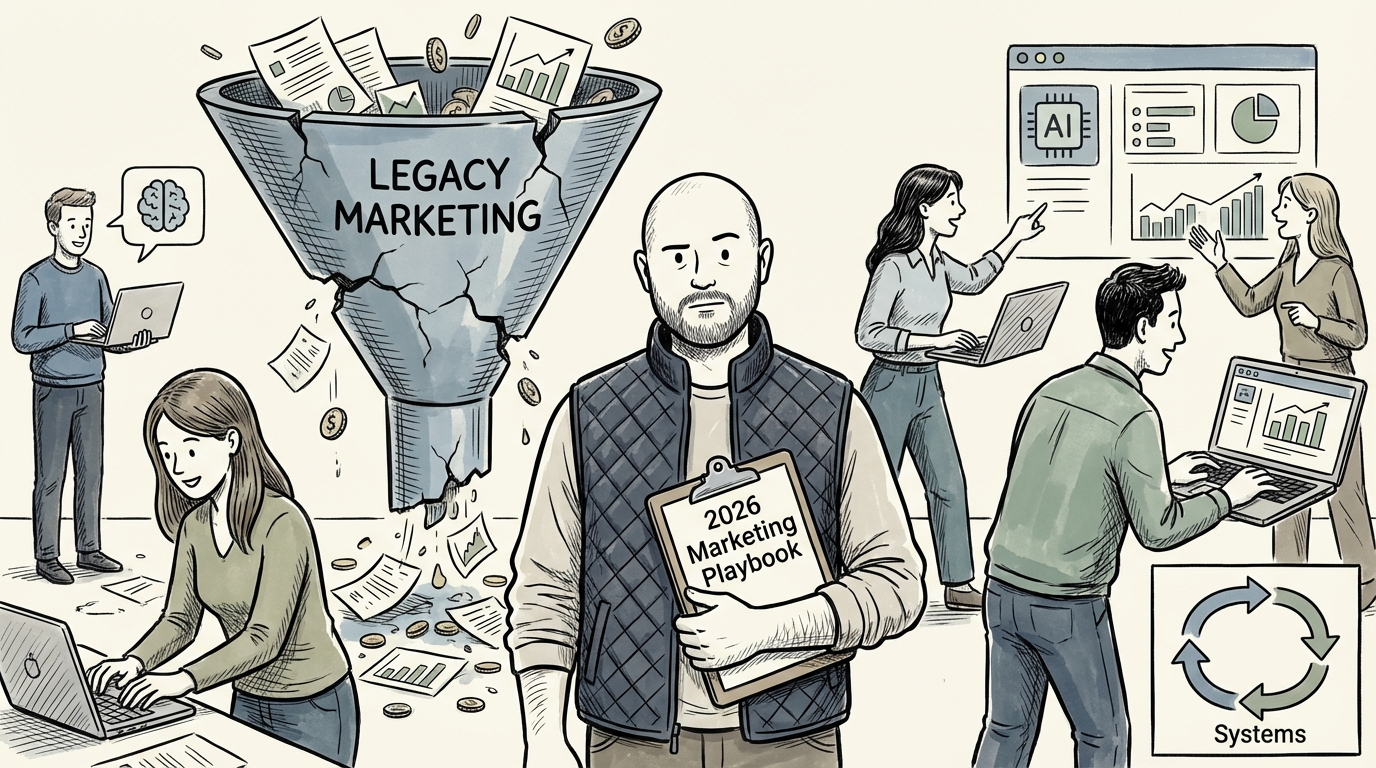
Traffic is leaking. Funnels are collapsing. Customer acquisition costs are creeping up. And a lot of teams are quietly realising their old playbooks just don’t work anymore.
This isn’t a tooling problem. It’s an architecture problem.
Welcome to what I’d call The Great Erosion: a slow but very real breakdown of legacy acquisition models — happening right under most marketers’ noses.
Let’s talk about what’s actually changing, and how the best teams are adapting.
Here’s the stat that should stop you in your tracks:
Nearly 60% of searches now end with zero clicks.
Why? Because AI answers the question directly on the results page. No blog click. No landing page. No retargeting pixel.
That single change quietly destroys the old, linear funnel:
Search → Click → Convert
Instead, we’re moving into information symmetry. Prospects now show up informed, sceptical, and halfway to a decision, sometimes with more context than your sales team.
So what wins in 2026?
Not more tools.
Not more content.
Not more headcount.
What wins is how well you orchestrate intelligence.
The teams pulling ahead all share one trait: they’re built for speed, not scale.
Think Human + AI Operators, not bloated departments.
Here are the shifts that actually matter:
Google is just one surface.
Discovery now happens across:
If you’re only “doing SEO”, you’re invisible in half the buyer journey.
Connected TV (not traditional broadcast TV) for B2B is one of the few remaining arbitrage plays.
Why? Legacy firms are stuck pouring budget into “what’s always worked”. That leaves CTV inventory underused and full of opportunity for teams willing to experiment.
CTV inventory is being bought mostly by consumer brands, not B2B.
That creates a classic arbitrage:
Brand-led broadcasting is fading.
Creator-led pipelines are winning because authority travels faster than logos. A credible human explaining something clearly still beats any polished brand message.
The best teams aren’t fully automated, they’re human-in-the-loop.
They orchestrate four flows:
AI does the heavy lifting. Humans provide taste, judgement, and ambition.
Search Engine Optimisation is quietly turning into Answer Engine Optimisation.
The goal isn’t ranking links.
It’s becoming the answer the model synthesises.
That’s a very different game.
The classic funnel is basically a polite form of pressure.
Gate this.
Nudge that.
Create urgency.
Hope for the best.
In 2026, that approach feels… off.
The alternative? Marketing Playgrounds.
Instead of pushing people forward, you let them explore.
A simple framework that works incredibly well here is:
To do the “Problem” part properly, high-performing teams use what I’d call a clinical approach:
Practical shift:
Stop gating PDFs no one reads.
Start shipping diagnostics, benchmarks, and interactive assessments that give value immediately — and feed your insight loop at the same time.
Prompting was phase one.
Phase two is agentic workflows, systems where multiple AI agents work together across a full process.
This doesn’t replace expertise.
It amplifies it.
Think about competitive intelligence:
One agent monitors competitor launches.
Another analyses positioning changes.
Another maps that against your roadmap.
Another drafts sales counter-narratives automatically.
The marketer becomes the orchestrator — not the executor.
And here’s the uncomfortable truth:
If you don’t internalise agentic orchestration, you don’t just fall behind, you become irrelevant.
This isn’t about shaving hours.
It’s about staying in the game.
One of the most underrated shifts of this decade?
Non-technical marketers building their own software.
Tools like Cursor and Claude Code mean you no longer need to “wait for engineering”. You can just… build.
This is often called vibe coding — but don’t let the name fool you. It’s incredibly powerful.
The core structure looks like this:
Once you get this, you stop buying bloated SaaS tools and start building intelligence.
Custom dashboards.
Bespoke lead scoring.
Internal research tools wired directly into your CRM.
No tickets. No delays. No bottlenecks.
In 2025, multimodal AI quietly crossed a threshold.
Models like Gemini now understand:
Not just transcripts.
That turns YouTube into an intelligence goldmine.
You can analyse a competitor’s demo, stage presence, and “vibe” then reverse-engineer it into something better.
Combine that with new-generation tools for:
And suddenly, content velocity explodes.
The teams who win here aren’t louder, they’re sharper.
Loop Marketing is Hubspots answer to the Funnel leak. They have seen their inbound organic traffic fall off a cliff (like everyone else). So the best and brightest have come up with this new strategy as they have figured out that in AI-heavy markets, growth comes from feedback-driven loops, not linear journeys.
A simple loop that works:
Define your point of view before AI touches it.
Use agent personas to simulate customers, pressure-test ideas, and run instant “focus groups”.
This isn’t first-name personalisation.
It’s contextual relevance — the kind that feels oddly specific. Hyper-local references. Industry in-jokes. Signals that say, “We get your world.”
(When done well, conversion lifts can be dramatic.)
Meet buyers inside AI engines themselves.
That’s where AEO comes in: shaping content so models surface you as the answer.
No more post-mortems weeks later.
Feedback updates messaging, targeting, and offers in near real time.
That’s how loops stay alive.
Here’s the honest assessment:
Most ambitious marketers today are ahead of the average but still behind the opportunity.
The upside in this shift is 10x to 100x bigger than most people realise. But only if you stop thinking in campaigns and start thinking in systems.
Headcount is no longer leverage.
Tools are no longer differentiation.
Orchestration is the skill.
If you do one thing over the next 12 months:
That’s where the real edge is forming.
And quietly, right now, that’s where the next generation of breakout marketing teams is being built.